

Service 05
Technical Reports: Defects, Measurements and Planning
We check the condition of your property and, where there are construction or planning defects, we try to find a way forward. Reports on existing extensions, ITE, IEE, building defects, measured surveys and preliminary studies for legalisation.

It all starts with a measured survey. Before any report, certificate or piece of advice comes something fundamental: understanding the property.
Which technical reports do we offer?
- 01 Extensions report
- 02 Technical defects report
- 03 Floor plan and measured survey
- 04 Expert witness report
- 05 ITE and IEE
- 06 Planning report
Where we work
We work mainly in Torrevieja and across the Vega Baja del Segura.
- Torrevieja
- Orihuela
- Orihuela Costa
- La Zenia
- Playa Flamenca
- Guardamar del Segura
- Rojales
- Ciudad Quesada
- Pilar de la Horadada
Report 01
Extensions report
Would you buy a property without knowing whether all its square metres are properly documented?
Many buyers find out too late that there are extensions, alterations or floor areas that do not match the property’s paperwork. We have developed a report that helps buyers, sellers and estate agents understand the real situation of a property before the deal closes.
We check
- The property’s actual floor area.
- The Land Registry and cadastral records.
- How long any extensions have been standing.
- The next steps on the planning side.
Frequently asked
Can you check whether a property’s floor area matches the cadastre and the Land Registry?
Yes. We can measure the property and compare the physical reality with the available paperwork to pick up any discrepancies.
Do I need an extensions report before buying a property?
It is not compulsory, but it can be well worth it before a purchase, particularly where there are doubts about extensions, enclosures or alterations that do not show up clearly in the paperwork. Through the report we can check the actual floor areas, compare them with the cadastral and Land Registry records and establish how long any extensions have been standing. That way the buyer gets a better picture of where the property stands, spots any discrepancies, and can weigh up — before buying — whether there are planning constraints or possible legalisation problems that could affect the property.
Report 02
Technical defects report
Before buying a property, a technical inspection is always worth having.
Knowing in advance what is wrong with the building can inform both the decision to buy and the negotiation. The inspection rests mainly on a visual survey, with photographs taken and a report written up describing the faults and defects found. We also have additional equipment for finding hidden problems.
Testing equipment
- Thermal imaging camera.
- Void and cavity detector.
- Inclinometer.
- Moisture meter.
- Window glass thickness gauge.
What does the client get?
A report in which we record and describe every fault found, with a provisional diagnosis of why it has happened. Where there are any, we list the more serious faults that you should weigh carefully before buying the property.
Frequently asked
Does a defects report guarantee there are no hidden problems?
No. The inspection is carried out mainly visually and with the testing equipment available. The report sets out the faults and anomalies that can be detected during the inspection, but it does not take the place of specific tests or opening-up works where those are needed.
Report 03
Floor plan and measured survey
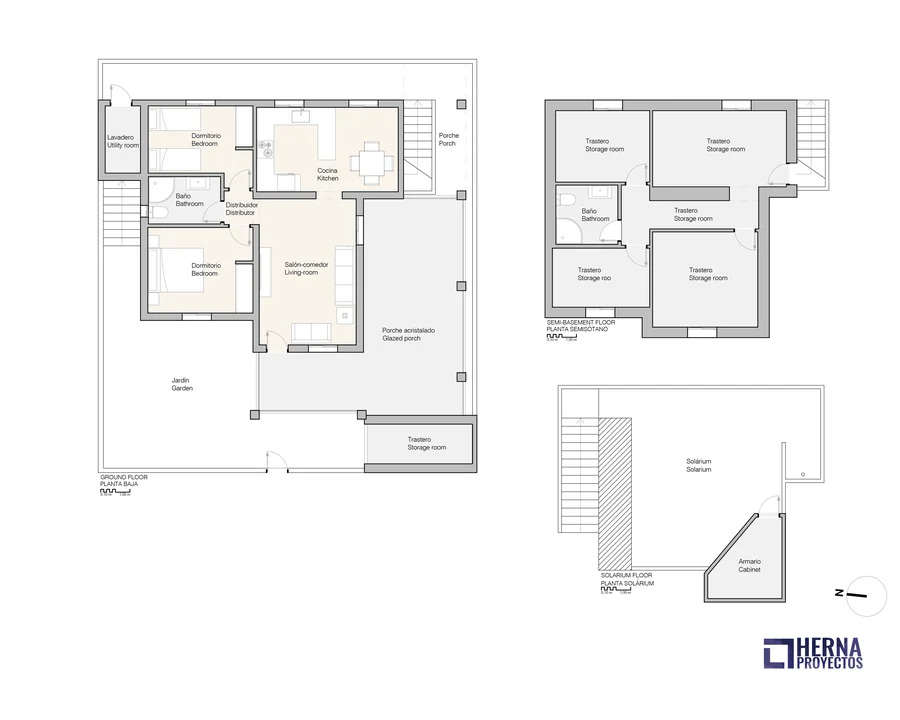
If you are putting your property up for sale, include a floor plan in the listing.
It tells a prospective buyer far more. We measure the property, draw the plan and lay it out so that it looks good — like the example we have put here. With a measured survey you know what your property really measures, since the floor areas in the paperwork are often unclear or imprecise.
Report 04
Expert witness report
Party-appointed and court-appointed experts.
We produce expert technical reports analysing damage, construction defects, discrepancies, breaches or any other technical question relating to a property. We bring our technical knowledge to bear in documenting and assessing the facts objectively.
When might one be needed?
- Building defects and construction damage.
- Faults or latent defects in building work.
- Disputes between owners, developers or contractors.
- Disagreements over work carried out.
- Technical assessment of damage and repairs.
- Breaches or construction shortcomings.
- Technical support in court proceedings.
What do we do?
We inspect the property, gather the necessary information and documents, analyse the circumstances of the case and produce an expert report with the corresponding technical conclusions. Where necessary we carry out measurements, photography and checks using specific equipment. We can also confirm the report on oath and appear before the courts when called upon.
Frequently asked
When do I need an expert technical report?
When there is a dispute or claim in which damage, construction defects, breaches or other matters relating to a property have to be technically established and assessed. The report can serve as technical evidence for an out-of-court claim or for court proceedings.
Can you act as party-appointed or court-appointed experts?
Yes. We act as both party-appointed and court-appointed experts, producing technical reports and, where necessary, confirming them on oath and appearing before the court to explain their conclusions.
Report 05
ITE and IEE
Technical Building Inspection and Building Evaluation Report.
If your building is over 50 years old, or you are an owners’ association looking to apply for some form of grant, you may well have been asked for an ITE or an IEE.
What is the difference between an ITE and an IEE?
The ITE reviews the building’s state of repair: structure, roofs, services. The IEE, as well as covering the work of an ITE, also assesses accessibility and energy performance.
Frequently asked
When is an IEE compulsory and what does it cover?
The Building Evaluation Report establishes the building’s state of repair and assesses matters such as accessibility and energy performance, to whatever extent applies in each case. Whether it is compulsory depends on the building’s characteristics, age and the rules that apply to it, so we can advise you on whether one is needed and what work it may call for.
Report 06
Planning report
What can be built on your plot, according to the local ordinance.
This means consulting the municipal ordinance that governs the planning rules for your plot or property. Those rules tell us about the remaining permitted floor area, the boundary setbacks — the strips that have to be left clear of building — the number of storeys and the other parameters.
What is it for?
- Establishing whether a project is feasible: what can be built, or what works are permitted on a plot, before buying or starting work.
- Looking into legalising existing buildings: whether extensions or earlier structures can be regularised from a planning point of view, bearing in mind that they will also have to comply with other rules such as the Technical Building Code.
- Planning renovations and extensions: the real scope for extending your current home under the planning rules in force.
Frequently asked
Can you tell whether an extension is lawful?
We can look into its planning situation, paperwork and age, and weigh up the possible routes to regularisation. Whether legalisation is possible will depend on the particular circumstances of the property and on the applicable rules.
Can I find out what I can build or extend on my plot?
Yes. Through a planning study or report we can analyse the applicable planning rules and the main parameters that constrain the work.
Not sure which report you need? Tell us about your case and we will say which one applies and what documents are required.
Let's talk